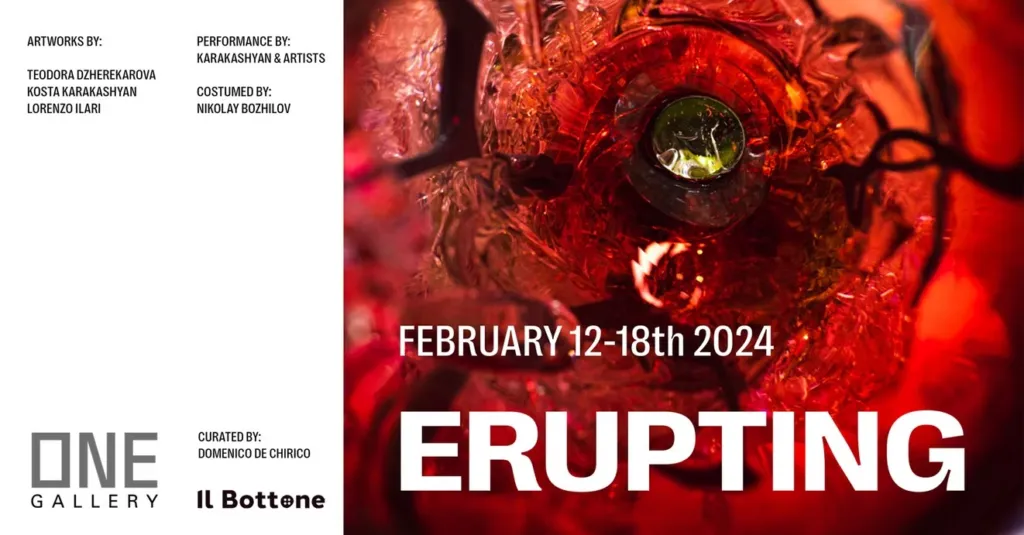
“ERUPTING” “Because pain is more painful when it is silent” Giovanni Pascoli – Nuovi Poemetti (1909) – from “Il prigioniero” Contemporary society—bold and unpredictable—heralding significant and rapid change, preaching random goals and unexpected suffering, is increasingly and ever more quickly saturating itself with feelings that merge into what we all recognize as distraction or emptiness, one of the constitutive phases of collective life. An undeniable consequence of all this is the pathologization of anger: an excessive and sudden emotional eruption, marked by an unavoidable тревога— a signal that something is not moving in the right direction. On this question, Aristotle, in his ethical treatise entitled “Nicomachean Ethics”, probably dedicated to his father Nicomachus, argues that virtue is always a balance between excess and deficiency, emphasizing that neither any virtue nor any vice is entirely good or entirely bad, but rather a matter of symmetrical harmony. This applies to anger as well. Anger is not bad in its essence, but it depends entirely on human action, bearing in mind that “state” is not sufficient and “activity” is also necessary—more specifically, in the form of power and action. And so anger, the emblematic manifestation of deep personal and inner suffering, becomes the most immediate response to the absence of this idea of “full” happiness. Therefore, only by passing through this difficult crossroads, marked by cathartic aims, can we secure a new form of balance for ourselves. On the basis of these assumptions, “ERUPTING”, in an attempt to direct the irrepressibility of bottomless pain toward tenderness and beauty, is grounded in the Aristotelian axiom that “to get angry is easy; anyone can do it; but to be angry with the right person, to the right degree, in the right way, at the right time, and for the right reason is not easy—and especially not for everyone.” Moreover, according to the philosopher Emil Cioran, “ERUPTING” speaks openly to all those who stand “before a world, united in the crude and the terrible,” to all of us who “have phenomena in our blood,” who are born already “in the trembling of the visible,” and for whom every strategy aimed at “liberation from oneself and from everything” includes the virtues of insight, care, and awakening. Thus, “to become useless, we must cut our roots, become metaphysically alien.” At this point, it is inevitable to ask: “Today, who is interested in the soul?” There follows a possible and strongly desired process of appeasement which, supported by movement, pushes emotions to the point of irreversibility that ends in an explosion; a search for balance that avoids violence yet processes certain emotional states, channeling them into a benevolent and liberating flow. In this bold attempt to explore human emotions, the multidisciplinary Bulgarian dance company Karakashyan & Artists collaborates with the “Il Bottone” Foundation, together delving into the complexity of mental health and the processing of anger through a performance and an exhibition entitled “ERUPTING”. The performance features four dancers who confront the different nuances and expressions of anger, painting with their bodies rather than brushes in order to materialize the embodiment of anger itself, transferring it onto blank canvases. As they writhe, they spontaneously fling paint onto the canvases, leaving traces that form vivid and original works, bearing witness to the ephemeral nature of our emotions. Every movement becomes an unrepeatable, passionate, painterly gesture, defining this inner revolt, which proves to be immaterial. Karakashyan & Artists, known for their engaging avant-garde productions that embrace the beauty of the intimate and the inner, invite the audience to immerse themselves in the pulsating energy of this performance. By interweaving the presences of dance and the visual arts, they create a compelling narrative that calls viewers to frank participation in a dialogue about the importance of acknowledging and understanding the complexity of articulated human emotions. Domenico de Chirico