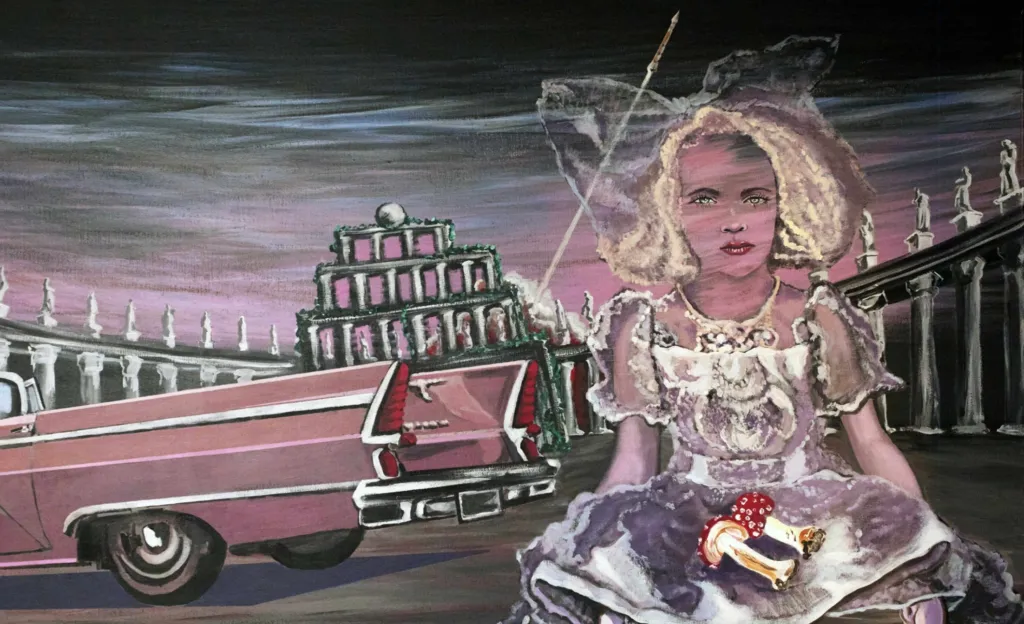
The “DEAD END” project is a natural outcome of the idea for a continuation of the television series “Undercover,” created between 2011 and 2016. Dimitar Mitovski is widely known as a director, but few know that he began his career as a visual artist more than twenty-five years ago. The present exhibition marks his return to the world of visual art, more inspired and committed than ever to this field of creative practice. While working on the script for the series, he simultaneously produced sketches and storyboards for several key scenes, constructing a new, imaginary environment for the characters, who find themselves in a parallel world—“Purgatory.” Drawing gave clear visual form to his conception of this “place,” as he calls it in the script. During the writing process, the artist-director accumulated enough works to prompt him to envision something on a larger scale—namely, an exhibition. To achieve their full visual impact, they needed to be rendered as large-format paintings. This is how the exhibition “Dead End” came into being. It presents seven painted diptychs, a selection of his conceptual sketches, and excerpts from the screenplay of the film we are about to shoot. “The exhibition should be viewed as an autonomous work governed by the principles of visual art,” the artist states. “Dimitar Mitovski was among the first artists from Eastern Europe to experiment with the possibilities of cinematic art. During the ‘dramatic period’ of the transition in the early 1990s, Bulgarian television prompted the artist to use the medium itself to convey an important message to the public. Reading and decoding the social references in his manifesto for the ‘Spatial Movement for Television,’ Mitovski passionately championed television as an artistic medium. The technologically driven artists involved in the short-lived spatial movement of the Rŭb and Disco 95 groups—with Mitovski as its ideologue and active participant—often presented ‘new art forms’ on television, albeit to a decidedly small audience. Nevertheless, they also influenced the following generation, which expressed itself through new media, including television as a subject, material, and medium for cultural expression.” Desislava Zafirova /curator/