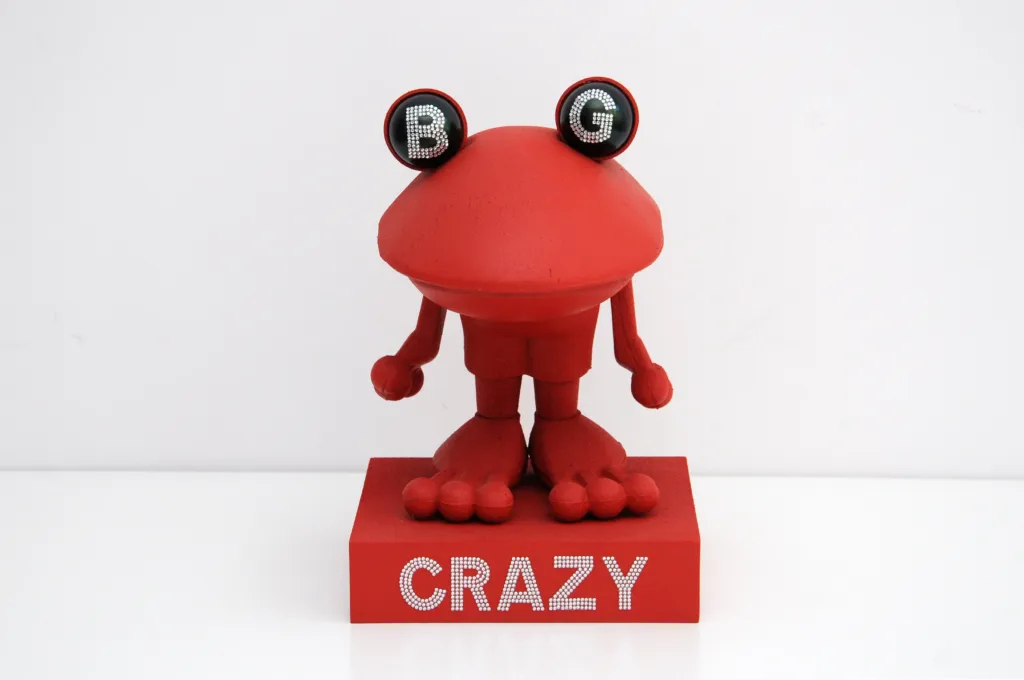
LEADING SERIES The collection of works in the YONKO’S ARK project consists of two leading series: Azeruis Rising and Crazy is the New Red. The primary link between these collections lies in the colors that unite the objects. IN THE BEGINNING WAS COLOR We live in a kaleidoscopic world in which color has a significant influence on our perceptions, communication, emotions, and relationships. The history of color is connected not only with various aspects of our lives, but also with the evolution of humankind. The subject has been extensively studied by many scholars; some of the most remarkable works in the field are by Michel Pastoureau, the only person thus far to have dared to write a “History of Color.” EVERYTHING BEGINS WITH BLUE: If the history of colors begins with red, that of YONKO’S ARK begins with blue. Why? Because this is the color of true evolution! In Ancient Greece and Ancient Rome, they had no word for it, whereas today it is the favorite color of more than half of humankind. Having reached the shores of Venice in the form of lapis lazuli—also known as azurite—from mines in Afghanistan, it makes everything invisible or intangible visible: the sky is blue, but can you touch it? NO! Thus, in the age of Surrealism, it became the color of our dreams and, by extension, our aspirations. One of our greatest longings is also associated with the first view of Earth from space. Whether Armstrong or Gagarin was the first to see the “blue planet” is not the subject of the present exhibition, but it is a fact that everything precious in the world around us is blue. This is the main reason why one of the series is titled “The Rising of Azurite” (Azeruis Rising). It preserves the artist’s intimate childhood memories, objects, and emotions—and even his fears. Like every color, azure blue has its demonic sides as well. As I mentioned above, red was the first color to reach us and the first to be fully mastered by humankind. Red, however, is the color with the strongest ambivalence. It is the most natural, the most predictable, and its ambivalence is linked to its association with joy and pleasure, which in turn are “the most direct path to hell” and to the flames of the inferno. Who did not hear the story of “Little Red Riding Hood” as a child? Yonko is not the only one to have wondered: why exactly red? It could have been pink or green. If you belonged to Yonko’s generation, there were reasons for this color to accompany you so often as a child. There were two: first, wearing red made you easy to spot; second, pagan customs held that red warded off the evil eye and envy. Even so, it is madness to cross the forest in a red hat. Dangers lurk there, and you are certainly not wearing camouflage. Literally translated, the name red means beautiful, and most of the objects in this color in YONKO’S ARK are created with a certain irony and irreverence toward the concept of “beauty.” Beauty becomes completely intertwined with madness, opposing the assertion that art is good only when it is beautiful. YONKO’S ARK “And so God asked Noah to do something strange. He told him to build a great ark. The ark was as large as a ship, but looked more like an enormous, elongated chest.” No, this is not the story of YONKO’S ARK, and the only point of contact between Noah’s ark and Yonko’s chest is that both objects were conceived as vessels for preservation. In Yonko’s particular case, what is preserved is the creator’s legacy—the thing that enables him to live on. Blue continues to play the leading role established in the project’s first part, but this project also includes several “pointed accents” that have accompanied the artist from childhood through his encounter with the local art scene. These include works such as “Chocolate Dreams.” The sculpture serves Georgi Dimitrov’s chocolate head for dessert—an ironic analogy to the sweet tales of an entire era that melted like chocolate after the fall of the old regime. Other works of this kind include two pieces from the Smart is the New Sexy series. The first bears the subtitle Curator’s Talk: Timova & Artelina. In the sculpture, the curators are drowned in their own ambitions as unrealized artists. The second is subtitled Pink Freud, and its message is direct and explicit. YONKO’S ARK IS THE TREASURE CHEST OF A HUMAN LIFE. A LIFE IN WHICH THE ACCUMULATION OF KNOWLEDGE, HERITAGE, EMOTION, AND CREATIVITY NOT ONLY SHAPES THE ARTIST’S POSITION, BUT ALSO FORMS PART OF HIS LEGACY TO THOSE WHO DREAM OF AN ARTISTIC CAREER. AND HIS MESSAGE IS SIMPLE: “TO BE A GOOD ARTIST, THE MOST IMPORTANT THING IS TO BE AUTHENTIC AND TRUE TO WHAT PROVOKES YOU TO CREATE!” Tsvetelina Anastasova