WHITE EXHIBITION 3.0
A project by Iskra Blagoeva
April 8 – May 7, 2021
Artists:
Iskra Blagoeva
Nina Blagoeva
Valentina Trayanova
Boryana Petkova
Mariela Gemisheva
Iskra Blagoeva / Daniela Radeva
Stela Vasileva
Simeon Simeonov
Alexander Gabrovski
Society
The first two editions of “White Exhibition” were solo projects by Iskra Blagoeva, but this time she uses her ability to engage people in joint initiatives and forms a small artistic society. At first glance, it seems her intention is to curate the exhibition, but there is something more to the way she does it than just “oh, I’ve been on the phone all morning” or “we haven’t decided on the pedestal dimensions yet.” Just as she organizes, mixes, and involves friendly, professional, and family relationships in various activities, she uses the exhibition to compensate for the lack of direct communication in so-called “artistic life.” The official formal tone does not work here. Thus, the organizational actions themselves acquire the characteristics of an artwork.
White
Snow, snowdrops, innocence, wedding dresses, white painting, white neon, transparency, white sphinx, white performance, light… We associate the expression “winter is coming” with snow and Christmas, but also with darkness, with the long “Night of the Middle Ages.” “White Exhibition” is held periodically, alternating with “Black Paintings of Joyful Events” – logically, there is no light without shadow. I see white as a metaphor for the feminine, for the expectation of a woman to be untainted and the courage to “taint” yourself. White clothing has also become quite political in recent years. Many women with a stance, like Alexandria Ocasio-Cortez, appear publicly in white clothes as a symbol of new beginnings, strength, and solidarity with the suffragette cause.
The “F” Word
The “F” topic has a bad reputation because of female artists who follow the F-movement by the book and try to impose some learned and insincere morality. In contrast, Iskra Blagoeva interprets gender issues and lives her life by her own logic, correcting and reshaping the norms of F-doctrine as she sees fit. For example, continuing to like, even adore men, and playing them like a game of chance.
Nina Blagoeva / Mama, (Im)perishable, 2021
Nina Blagoeva depicts a romantic landscape with picturesque ruins and seems to contrast it with the linear handwriting of the “child.” Here, the decision of what to paint appears as a reference to Heinrich Wölfflin’s pairs of fundamental concepts in art history. In his study, he compares the “line guided with regal confidence by the hand” and the “illusion of incessantly gushing, never-ending movement” in what he calls “painterly painting.” From this perspective, Nina Blagoeva’s position in the exhibition can be recognized as commenting and critical. The “painterly” as an intention is close to the illusionistic and is at the opposite pole of the “linear,” which follows not appearance but knowledge of objects and therefore points toward the contemporary idea of “conceptuality.”
The invitation for her to participate in the exhibition is a middle finger to the patriarchal society in which she lived. A response to a series of prohibitions in our family – first from the Party to my grandfather to become an artist, then from my grandfather and grandmother to my mother to study painting. Also, her forced education as an engineer, all the pressure from the macho generation of that time that influenced her life.
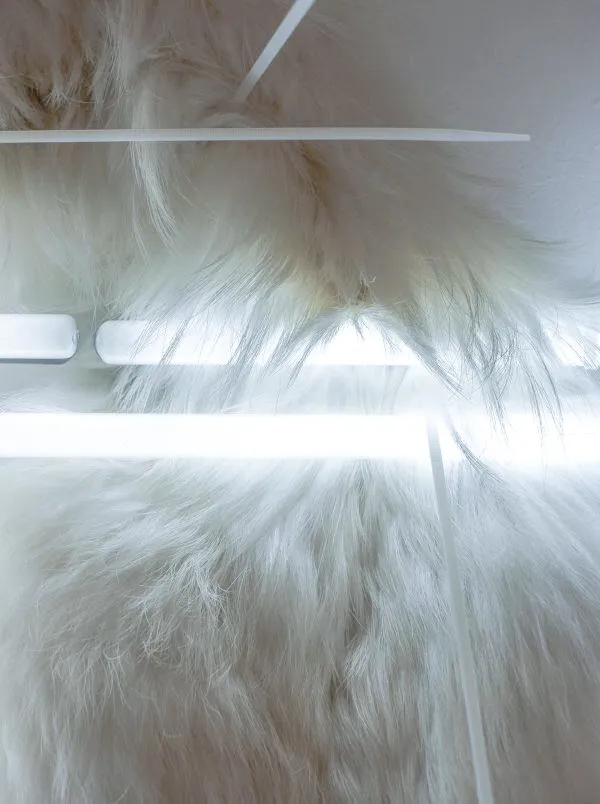
Iskra Blagoeva, Sign of Faith and Devotion, 2021
The best thing about this work is that moral categories are re-evaluated and there is no hint to the viewer whether to marvel or be outraged. The direction is clearly set through the good old symbolism of materials and means of expression – the comparisons between neon, zip ties, and an ultra-luxurious arctic fox cape raise the question of the connection between toxic masculinity, misogyny, and cruelty to animals. It is also about morality – about the woman who can be bought; about the successful woman who is immediately called a bitch and stripped of her femininity; and generally about condemnation.
Valentina Trayanova, I change everything, 2011
This sound sculpture can be read as a response to the viral video with Cynthia Nixon “Be a lady they say.” But in fact, there is no political subtext at all. Valentina Trayanova works mainly with the form of words and sounds. The repetition of the word “change” is like hypnosis for the listener, who is given an impulse to interpret freely. Besides, her voice sounds so seductive! Perhaps for the first time, she is freely releasing this sexy potential of her voice.
Boryana Petkova, Spill the Beans, 2021, video
The theme of communication, recreated through a perhaps painful performance. She literally chews polite words in the form of glass casts from the inside of her oral cavity. I like how she deforms the words and, in parallel, deforms the gentle, pink, cliché image of the woman. And she also tosses out the idea of the “impenetrable sphinx,” just as it stands with another work in the exhibition – Oedipus was a cheater, 2020 by Iskra Blagoeva. She also brings up the theme of emotions and restraint – “there is no problem with a woman suffering, as long as she suffers beautifully,” they say.
Mariela Gemisheva, Self-Portrait, 2008
A fragment of a cycle of photographs taken as a photo shoot. In this work, Mariela Gemisheva places herself in the position of an object of observation. She recreates a burst of aggression directed at a completely innocent wedding dress, literally tearing it apart before the eyes of the photographer and the audience. In this shot, she is completely covered, as if under a burqa, whereby the aggression already becomes contagious for those watching. It awakens empathy. Now this is a pure form of “militant feminism,” yet presented very sophisticatedly.
Iskra Blagoeva and Daniela Radeva, Greetings from the Punk Women to the Section of Women Artists of the Association of Women with Higher Education, 2021
A work in two parts – painting and the present text, both with shared authorship. Let’s just mention that these are not professional experiments of the “role reversal” type, but an attempt to achieve an extreme degree of intimacy in the relationship between artist and curator.
Stela Vasileva, Great Mullein, 2021 and Vertical Foundation, 2021
No one so far has commented on the sense of architecture in some of Stela Vasileva’s drawings and, more often, installations. Here, her instinct to “build” becomes obvious in the juxtaposition of softness and hardness and through the constructive problem she solves to balance the glass rod. The subtext in her work, at first glance, seems to compromise the femininity of the exhibition with its vertical orientation. But we will by no means admit this, because we do not want to remember the expression “masculine painting,” used as praise for female artists during socialism by their male colleagues. The depicted plant, known as “Mullein,” “Sheep’s Tail,” or “King’s Candle,” has a hairy and unbranched stem, and its root penetrates deep into the soil. According to folk medicine, it helps against a long list of physical ailments, among which “hoarse voice” is noted.
Simeon Simeonov, untitled, 2021
I see the “feminine” in most of Simeon Simeonov’s works – a clean, minimalist, white canvas, white silicone. For me, this is the perfect summarizing work in the exhibition. The author’s qualities are obvious, especially for viewers with refined taste plus a sensory disposition for perception.
Alexander Gabrovski, Memento Mori, poetry, 2021
“Back to white”, performance, 2021
Alex is a poet and artist, and so to speak, “The chosen one” in the exhibition, as a representative of a brand new generation of authors. A new being, not a “man” with all the aggression on the shoulders of that word. Intelligent, well-read, sensitive, and unburdened by all the shit that occupies us as women in this exhibition. He participates with wise and yet childishly pure poetry. In his performance, his body will be an object among female gazes. His role is to emphasize the opposition between male and female as ridiculous.
Iskra Blagoeva and Daniela Radeva