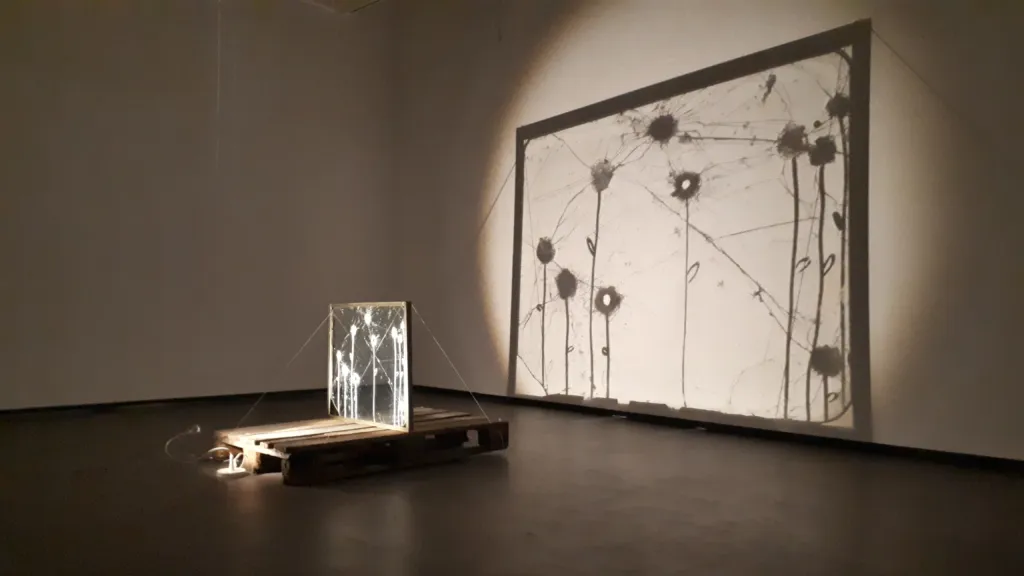
Artistic Mediation as an Art Form Born to a physician mother and a father from the Urals who built churches, the artist Sergey Rozhin recalls making the conscious decision to devote his life to art at the age of thirteen. The experience remains disturbing to this day: after being assaulted by a group of his peers at a summer camp, he began drawing incessantly to overcome the pain while recovering in bed. This biographical story matters only insofar as it allows us to trace Rozhin’s almost religious faith in the power and healing qualities of naivety and mediation in contemporary art. Precisely so: the N-word, as base and filthy as the next—the M-word—stands for everything that the cynical art world dismisses as insufficiently—or insufficiently overtly—critical, ultimately overlooking the immense potential that a renewed sincerity can offer. One of his earliest works in the role of the artist as researcher and mediator between the realm where ideas reside and us, the human race, is the cartoon-like series of drawings Grandma Hip-Hop (2012), in which he recounts how his grandmother leaves her small village to visit the big city. Just as any “respectable” deity would do, she “descends” to see for herself how her culture lives, expands, and develops. The story begins humorously with the grandmother and a group of elderly women dancing hip-hop before a flock of geese in the yard. Driven by curiosity, the heroine—convinced that she is a mortal spirit, just like Santa Claus (alive only for those who believe in him)—leaves the village and arrives in the city accompanied by a small black duckling, an embodiment of her grandson, the artist himself. There they encounter a street cat, magnificent and strong, with one blue and one red eye—an intelligent creature of brutality that nevertheless lives respectably, unlike the other street cats, which have lost all trace of naivety. After a series of adventures and misconceptions, in a decidedly absurd final scene Grandma Hip-Hop finally recognizes her own immortality while standing on a public bus and looking into the eyes of an old woman who is exactly like her. Yet this woman also proves to be one of the incarnations of the “father of ideas” himself—a key figure in Rozhin’s art. Grandfather Street Art [Дядо Стриит Арт] is an ongoing “ritual,” as the artist describes it, begun in 2013 and continuing to this day. “The principal method of research,” he continues, “through which the essence of a person entering the parallel worlds of their own mind and the entire art world may be revealed is possible only through the practice of shamanism. As a shaman, I was chosen by the spirit of Grandfather Street Art, but I am not the only one, since I could not manage alone. This is a dialogue between equal principles and the world of ideas and the subconscious, where there is no simple answer to the question of the relationship between the idea of consciousness and the consciousness of ideas.” Born from an obsessive mania of an artist invented by Rozhin—one who sees in car headlights and streetlamps the burning eyes of a being from another dimension desperately trying to communicate with our world—over the years this “ritual” has become a means of testing whether it is possible to convey experiences accurately from one world to the world inhabited by the viewer of art. The experiments take the form of audiobooks, performances, musical events, and an entirely new language with its own alphabet. The shaman and the spirit naturally change along the way, as does their motivation. In the first and darker of the two acts into which Sergey Rozhin’s first solo exhibition at ONE MONEV Gallery is divided, the imaginary artist reappears—and may just as easily be the viewer. He walks through a field of dandelions toward a figure in the distance, which turns out to be the grandfather watching him. This is why, in the first act, a series of three glass installations titled Dandelions (2013–2018), which evolved concurrently and form part of Grandfather Street Art, takes center stage while the being observes in silence. Here the artist treats the concept of beauty as a found object in order to investigate its nature further. Relying on the primal instinct of people who are most often dazzled by large and spectacular images, the artist fills the gallery with beautiful floral shadows. Growing directly from the floor onto the walls, their large, delicate forms divert attention from their immediate source. Captivated and curious, the eyes eventually move to the glass panes rising from bare wooden pallets before the field of proliferating shadows, only to discover that these are, in essence, small bullet holes. Rozhin’s sole intervention in the three pieces of glass, collected from the streets of his native Yekaterinburg, is to draw images of flowers around them with a white marker and illuminate them. The exhibition’s second act, lighter in atmosphere, tells the story of a space that is both an altar and a prison for the artist. A flag hangs from the center of the ceiling, bearing a slightly altered version of Malevich’s iconic black square, enclosed within a white circle against a red background. Titled Malevich’s Swastika (2018), it is at once an homage, a segregation of fears surrounding past artistic forms that still await transcendence, and a call for the creation of new forms. The concise, logo-like image has a powerful impact because it employs recognizable symbols that convey, on the one hand, profound historical trauma and, on the other, a cornerstone of human thought in the field of art. Its meaning remains suspended in an intermediate state, and it is unclear to us on which side of the painted surface freedom lies. On one side of the flag, a series of portraits of muses appears on street banners, the muses themselves having migrated from the first act. Drawn in black against a white background in a graffiti style, the portraits depict female figures in urban settings bearing the head of a dog or bird. Resembling ghosts, they represent ideas that have entered the human world yet remain foreign. They wander the streets as if responding to a naïve incantation left on the city walls by an anonymous street artist, who lamented for a long time: “I searched for you everywhere.” In a world that appears to offer no clear guidance on how to “capture” images from other dimensions, Rozhin nevertheless attempts, as a true mediator of his kind, to set out a series of almost biblical commandments. Staged humorously in the spirit of an almost childlike animation between a police officer and an artist—who also wears his stereotypical “uniform”—the so-called illustrated guide unfolds across a series of posters. The viewer is given instructions on how to beat an artist properly so that he can duly pay the rent, emerge from depression, discover his own sexual orientation, or prevent a performance from taking place. In the series, Rozhin also demonstrates a practical technique for defeating the artist should he turn out to be Malevich: who knows, it may come in handy one day. Snezhana Krasteva /Curator at the Garage Museum of Contemporary Art, Moscow/