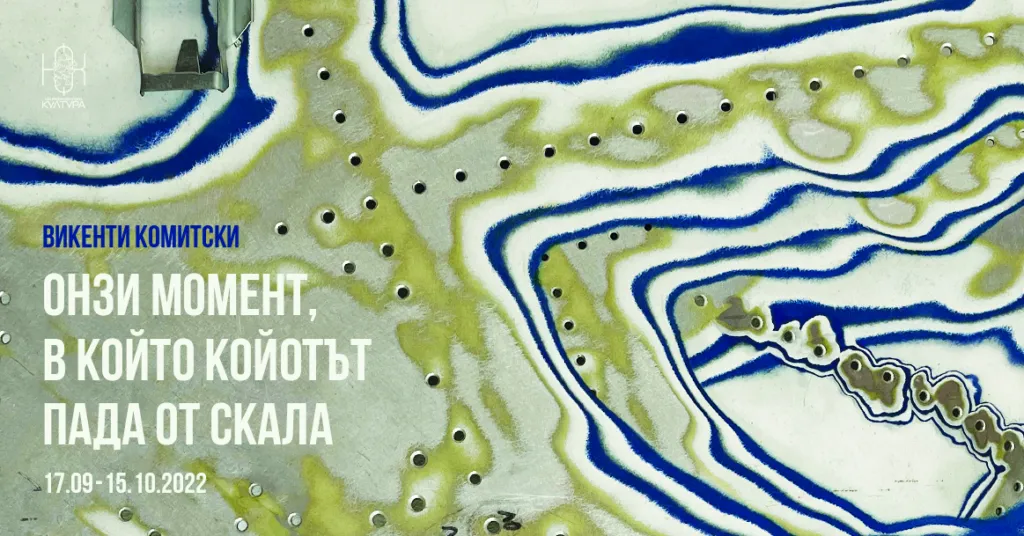
That Moment When the Coyote Falls Off a Cliff Solo exhibition by Vikenti Komitski 17.08–15.10.2022 Coyote Time refers to that moment in animated films when the hero runs past the edge of a chasm but only starts to fall once he realizes he is suspended in midair. “That Moment When the Coyote Falls Off a Cliff” by Vikenti Komitski transports us into a landscape after the end of time, where nature and the artifacts of industry undergo constant metamorphosis. The series of sculptures and assemblages is built from natural elements, found materials, and scrap. The exhibition traces several principal axes of conflict—nature, culture, and anti-nature; the primary and the derivative; the natural and the human-made. The stake of the latter is our own disappearance, as well as the panic of losing our original “endowment” with meaning. At the core of the narrative lies the human desire to overcome and subordinate nature, to appropriate its demiurgic functions and ultimately replace it in the role of a deity (a dead deity, as we know). In its drive for growth, it discards everything unnecessary and already superfluous. Forced out of its habitat, nature has turned into a spirit. It drifts through the air in search of a body to inhabit and finds it in metal structures, in the fragments of mechanics. Those, for their part, having spent centuries imitating it, sooner or later become it—or at least versions of it. In fact, it is precisely at the stage of their ruin that the objects we conventionally perceive as relatively non-ephemeral draw closer to organic matter, whose essential property is perishability—the linear movement of being-toward-death. The visual language of the works is an amalgam of two architectural fields: that of nature and that of the human vision of functionality (which often uses natural structures as models for its own), merging into a single common fabric—a system of organs. The objects of nature—bones, horns, relics of the momentum in which they once served life—find themselves on the same plane as fragments of machines and everyday construction implements. Vikenti Komitski’s works form a new enclosed garden—one in which nothing is alive. Yet inanimate matter does not pass into a stage of decomposition and decay (because what has never been alive cannot be dead). On the contrary, it undergoes unprompted transformations toward its own re-creation and renewal, becoming something else, as if overcoming the original doomed condition of creation, subjected to the forces of the external environment. The garden has no need of soil; its organisms possess their own synthetic roots and arteries. Under the sun of the new age, its inhabitants neurotically reflect its light; their pupils constrict painfully, reminding us that something is not right—that this sun is different. This garden of nature and industry is one from which the human being will not be expelled, yet is also condemned to live within.