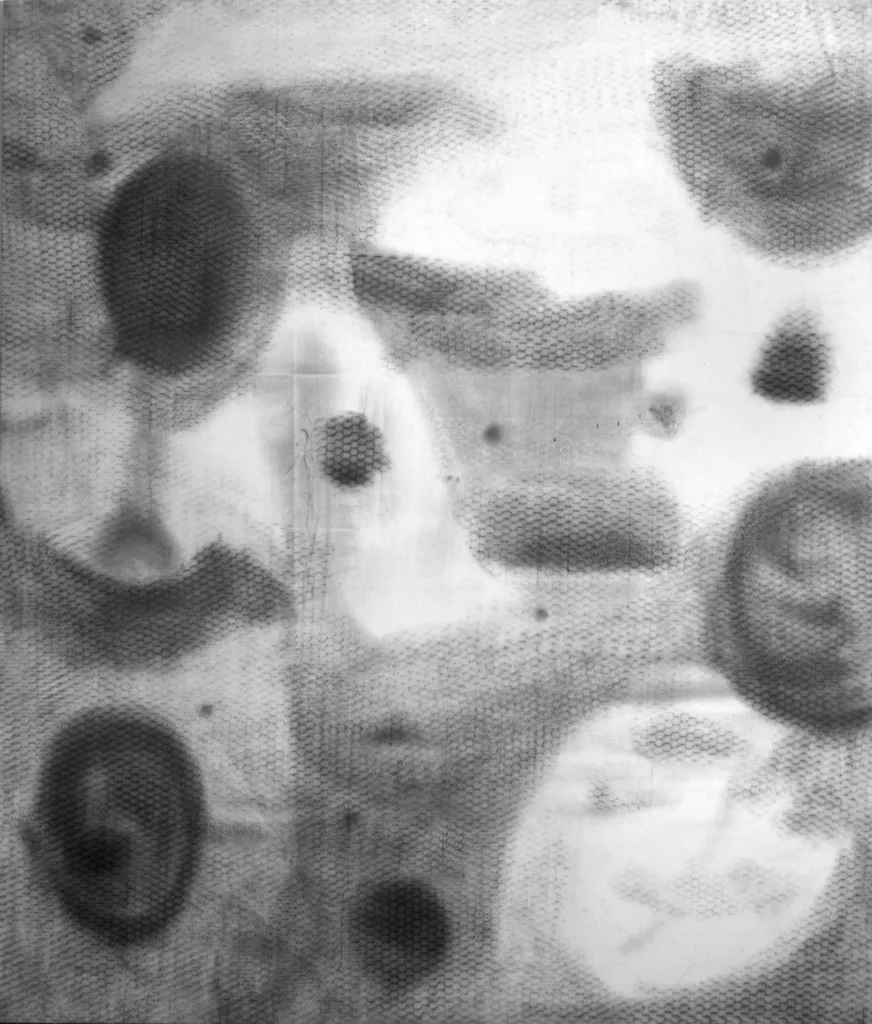
Milko Pavlov’s art is somehow memorable, despite its initially apparent lack of narrative. I vividly remember his sand surfaces from the early 1990s, as well as his large-format paintings with complex, rough surfaces shown at XXL Gallery in the middle of that decade. The reason for this acute focus and social presence is that, both then and now, the artist wins admiration not only through his rejection of figuration—or his exploration of its limits—but also through his repudiation of the combinatorial appeal of composition, understood as the visual “entertainment” of forms and colors that once characterized Bulgaria’s perpetually underdeveloped abstraction. Milko Pavlov thus generates a trajectory of development that is markedly important to Bulgarian art. It is possible to turn to the historical sources of this painting in order to understand it more fully, but doing so is probably unnecessary, since they can only partially explain the coding of Milko Pavlov’s graphite surfaces. The shadows of Antoni Tàpies, Yves Klein, Alberto Burri, Piero Manzoni, or Jules Olitski would probably point us toward a continuity with painting in which the surface and its relief simultaneously construct both the work’s material presence and its semantic levels. They would direct us toward a painting that asserts itself through the realism of its material specificity, but also through the psychology of that same specificity, since it is hardly immaterial whether we are confronted by a plane of glass, concrete, metal, or plastic. There can be little doubt that post-variability characterizes contemporary art. In this context, it is logical to assume that the key to understanding Milko Pavlov’s large gray canvases lies in the material and the technique. Yet although I have so far referred primarily to “surfaces,” this does not mean that we are discussing abstract art, or Art Informel. The impression is of a restrained yet simultaneously sensuous artist whose intentions are emphatically deliberate. The images generated by his technique can lead viewers toward the most unexpected visual associations within the limits of their individually bounded cultural memory. I emphasize that technique and process produce meaning here, insofar as the artist aims, in his own words, for the work’s “self-production.” The graphite image constructs itself because it is executed through frottage, and the intentionally produced result stands at the threshold of chance. In other words, this is a conceptual restriction of the work’s rational realization: it emerges before its creator’s eyes in the process of rubbing graphite onto canvas or paper placed over a particular textured ground. The aforementioned “frottage,” incidentally, derives from Surrealism’s visual experiments and, more specifically, from Max Ernst’s drawings, which takes us even further beyond the idea of self-contained, non-objective painting. The “human content” of these works is inevitably connected to the artist’s social sensitivity. In previous exhibitions, he publicly declared his interest in issues such as the catastrophic growth of the planet’s population and the question of faith, explored through the creation of “not made by human hands,” icon-like images. The fact remains, however, that no artist can stand continually beside their works to explain their concern about the possible evolution of the artificial intelligence “Sofia,” while the works themselves semi-transparently filter all manner of meanings. In that case, what exactly stands before us? It is difficult to discern in the frottages the anxiety arising from the existence of the mega-computer “Sofia,” because this is clearly an art that has deliberately distanced itself from the narrative legacy of Pop Art and Conceptualism. And this is not necessarily a bad thing, because for decades didactic political correctness has condemned contemporary art to a lazy predictability that is not especially productive, given that the influence of the visual arts is inherently limited and functions as a specialized mode of communication among people who, in one way or another, share humanist values. In this exhibition, Milko Pavlov asks questions and searches for his creative authenticity through the enigmatic filter of images surfacing in the viewer’s consciousness. We can never be entirely certain how our minds will respond to these ambiguous graphite rubbings, but in every instance there is the unpredictable metaphoricity of the conflict between the intangible and concrete matter. Socio-psychological science fiction may be a fitting description of Milko Pavlov’s works because, formally speaking, they signify nothing. They are materialistically concrete, yet the technique of their construction is elusively intentional and encourages personal perceptions—or even specific judgments, who knows. The graphite images may, for example, evoke the Shroud of Turin, while simultaneously insisting on matter as surface, on its transience, on the fragility of human memory, and on the relativity of space and time. This is precisely the opposite of the statistical pragmatism of artificial intelligence. Thus, the question—what is this before us?—may be answered along these lines: it is self-generating graphite, a form of matter that ambiguously transcends itself. Svilen Stefanov