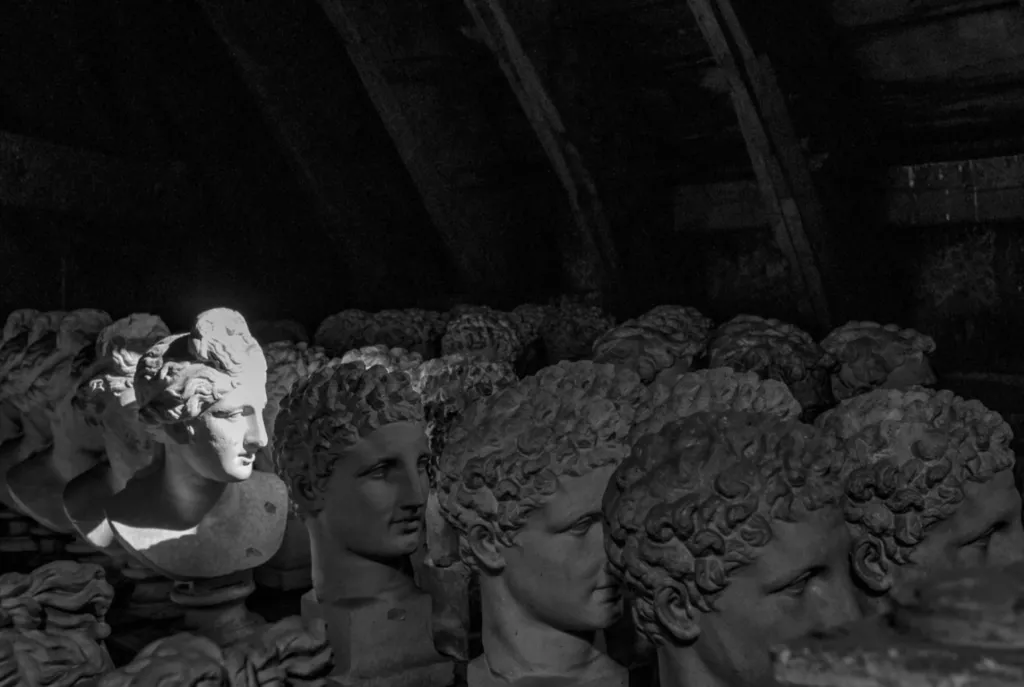
From the outset, the project bearing the Latin title SENSUS (Lat. sensory) draws the viewer into the depth of the spatial horizons captured by artist Gergana Mudova’s camera. Her name is familiar to the wider public through the large-scale exhibitions of leading international photographers that she has organized in Bulgaria in recent years, yet she is herself a remarkable artist—a fact that is perhaps not widely enough known. The exhibition presents nineteen limited-edition, large-format photographs selected especially for the occasion. The display reveals the sensuous, searching, and multilayered inner world of a refined artist. Gergana reflects on her working process: “Photography is sensation. It is an emotional process of revelation, discovery, and sharing. The mystery of the darkroom; the anxiety and impatience we experience while waiting for the negative to develop; the questions we ask ourselves until the process is complete. The darkroom is a womb in which we can be alone with our thoughts, contemplating in utter darkness as chemical processes reveal the images. Photography is a mirror of our perceptions. The laboratory creates a parallel reality, reveals the secrets of the unseeing, and teaches us to be intuitive and exceptionally precise. Photography is a guide to the subconscious. It mediates our message, exercising control over the viewer’s imagination.” Gergana Mudova studied illustration at the Willem de Kooning Academy in the Netherlands. Her creative journey also took her through Finland, where she found inspiration for the subjects of most of the works featured in the present exhibition. Gergana Mudova’s dedication is a calling and a way of life, unfolding as effortlessly as breathing itself… She further shares: “Photography gives us a license to see. We photograph with our hearts and minds; the camera is merely a tool. It is a hunter of reality, the mechanical womb of the image, the device that enables us to document striking images. Photography is a true emanation, a direct luminescence of what has vanished, making it possible to recreate an event. The photograph is not merely the result of the encounter between an event and the photographer. The act of photographing is itself an event, and it confers extraordinary rights—the right to see or to disregard what is taking place. The viewpoint brings the viewer and the photographer together as one. The lens delineates the boundaries of perception, determines the position from which we may see, and marks the line beyond which we may imagine what has vanished and begin a dialogue with the audience. Photography has the power to shock or idealize, to evoke a sense of nostalgia that blurs our notions of time and space, reality and fantasy. It is an illusion through which we create our own personal world. The speed of the gaze passes through the aperture, creating mirrored images. A place of dark, still water, with contours blurred in an atomic hue. A penetrating glow, veiled in mist amid even, airy tones, dissolves into a spectrum of dark colors. Vapors filtered through golden reflections permeate the atmosphere and polarize the image. The illusion is captured within the box of our imagination. Photography is sensation. It is a means of expression for those who wish to share.”