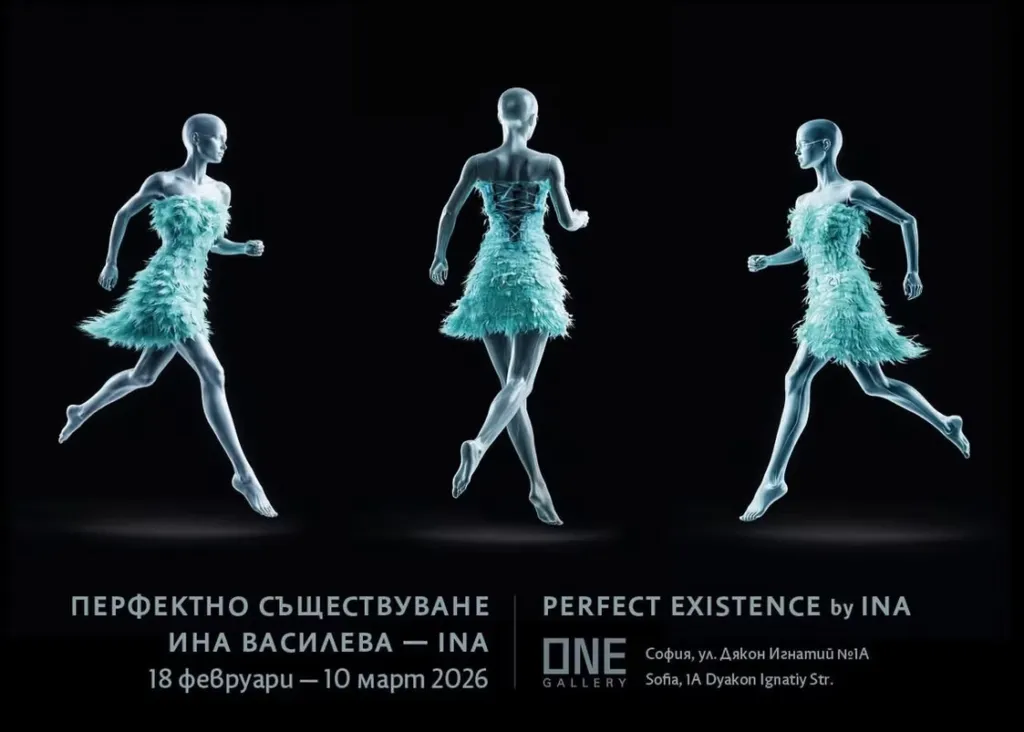
Perfect Existence | Ina Vasileva – INA | 18.02 – 10.03.2026 Curator Desislava Zafirova In an era of total visual production and algorithmic selection of reality, “perfect existence” has become a normative fiction. It is digitally calibrated, socially regulated, and psychologically internalized. Ina Vasileva’s project Perfect Existence functions as a critical incision into this fiction. Rather than representing perfection, Vasileva analyzes its architecture. Her images—often reduced, almost bodiless—occupy a liminal state: between presence and dissolution, between control and release. The figures do not pose; they exist. The space around them is not décor, but a psychic topography. This is an exhibition about the pressure to be whole in a world that fragments identity. Formally, Ina works with a minimal palette and a delicate dramaturgy of light. The silence in her compositions is active—it generates tension, not calm. Perfection is not a glossy surface; it is a moment of inner balancing in which the crack becomes a source of light. In dialogue with contemporary discourse on post-truth, digital hybridity, and performative identity, Perfect Existence proposes an alternative: existence outside the algorithm. Existence without the need for validation. The exhibition includes a spatial installation in which the works are not arranged linearly, but construct a fragmented environment—an almost meditative corridor of consciousness. The viewer does not consume an image; they move through it. The project does not affirm perfection. It deconstructs the need for it. Within a collection like this—where critical thinking and conceptual force lead—Perfect Existence positions itself as an inquiry into contemporary subjectivity: not through noise, but through precision. In the context of contemporary art, where themes of identity, authenticity, and digital hybridity dominate the discourse, Perfect Existence stands as a quiet yet categorical gesture. Vasileva works with minimalism of form and maximalism of emotional density. Her language is reduced, but not cold; conceptual, but not detached. The exhibition offers an experience, not merely viewing. The space is constructed as a zone of deceleration—a place where the viewer is freed from external projections and left alone with their own perception.