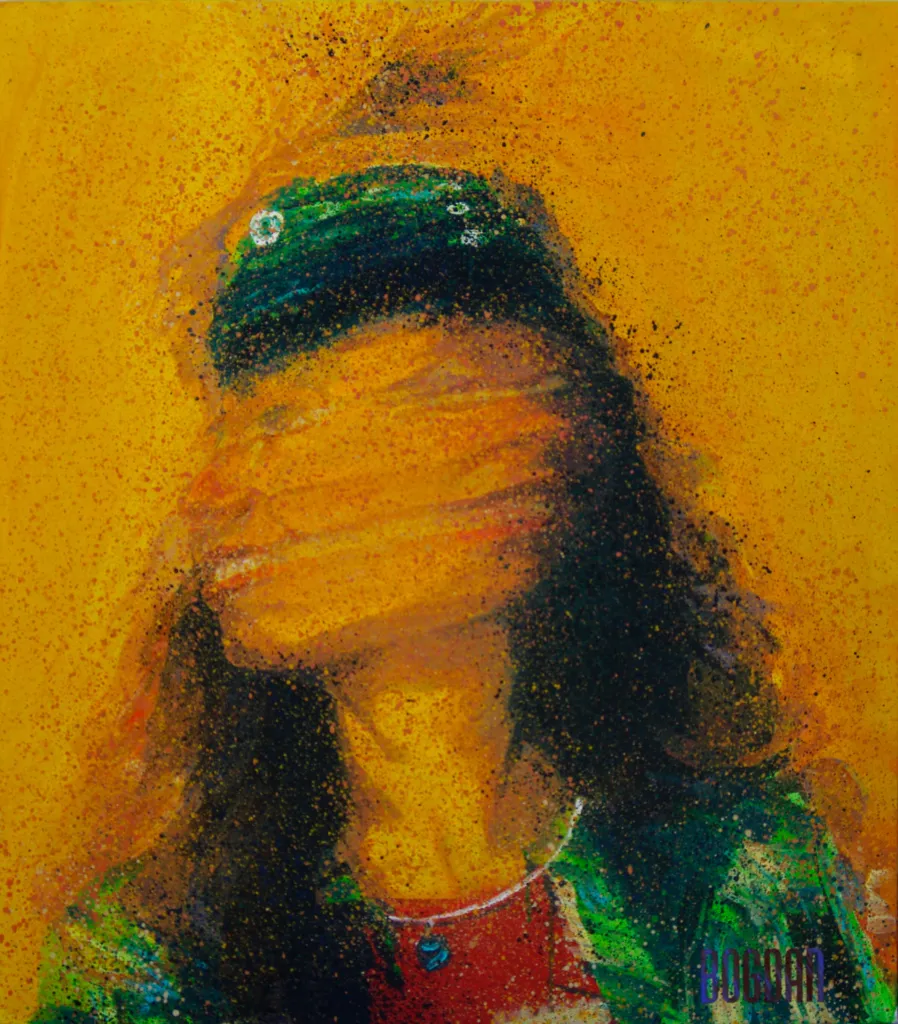
By analogy with the scientific method, and through symbolic references to the requirement that a source be cited—“opus citatum est”—the project proposes a model of the cyclical nature of time. This model is capable of offering evidence that past experiences of an artistic image, preserved in collective memory, can reappear through the prism of unceasing citation. “Pareidolia” brings together friends and colleagues as portrait protagonists who assume theatrical and operatic roles. Through distinctive props—hats and helmets—playfulness, and an amusingly slow camera shutter speed, the models enter quasi-roles that lend new perspectives to the artistic present. The stage movement integrated into the compositional space of the portraits transforms them into a simultaneous performance of a postdramatic nature. Gilles Deleuze defines the “movement-image” as intrinsically linked to an indirect representation of time: it represents time without presenting us with a concrete image of it; that is, it does not present us with a time-image. Informed by Deleuze’s definition, the project enables experimentation with the idea of the “exhibition-as-stage,” featuring a fixed “cast” rehearsing across different times and spaces. The result is a multiplicity of pareidolic images drawn from artistic practices with differing credos—each bearing its own temporal nuance and a truth faithful to the contemporary moment. The staged portraits reveal complex and diverse connections and interdependencies, richly dissolved between photography and painting, and photography and theatre, while settling into the image as painting and theatre. The paradoxical loss of a temporal framework—with no beginning, middle, or end—and its replacement by a “temporal loop” destabilize temporal unity and provoke an experience of time unlike the ordinary one. According to Barthes, “time crystallizes and transforms perception, turning delayed movement into a ‘form of time.’” It is as though the visual object on the stage retains time within itself. The flow of time becomes a “continuous present”—a present capable of drawing the viewer into the dramaturgy of portraiture, placing them in a state of artistic weightlessness while also setting in motion a stream of subjective reminiscences. The direction of “Staged Portraits” recalls the effect of a standing wave in a stationary medium. The movement of form—in this case, the image—“spills” toward the periphery of the picture plane, while the returning wave interferes with the wave that generated it, joining the image’s ongoing performance… And all this in a world that seeks to transform even its own self-image into pareidolia… Bogdan Aleksandrov