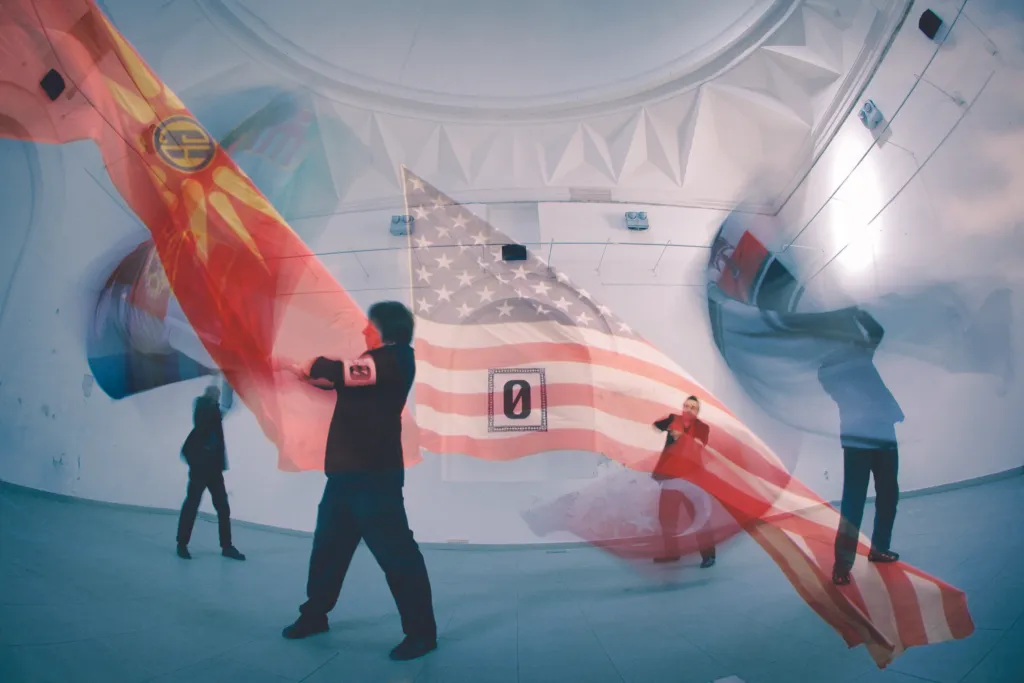
December 9 – January 10
ZERO Collective
Miodrag Desovski
Perica Georgiev
Zoran Janevski
Aco Stankoski
Bedi Ibrahim
Zlatko Trajkovski
Stefan Shashkov
Sinisha Cvetkovski
Sasho Jovchevski
Gorancho Gjorgjievski
The existence of the ZERO Collective is perhaps the most significant evidence of the occurrence of freedom in contemporary Macedonian art. Its beginnings can be traced back to around 1985, a time when the sense of an impending total change was becoming increasingly unstoppable. Of course, experimental works by authors such as Simon Shemov, Nikola Fidanovski, and the duo Miloš Kodžoman and Dragoljub Bežan could be noted as early as the previous decade. However, the ZERO Collective’s 1985 exhibition ‘Expression, Gesture and Action’ marks the culmination of a comprehensive process of cultural changes that were by no means limited to the then Republic of Macedonia.
Thus, the group’s work is associated with the artists Bedi Ibrahim, Miodrag Desovski, Perica Georgiev – Pepsi, Tatjana Miljovska, Aco Stankoski, Igor Toshevski, and Zlatko Trajkovski. Their meeting place was ‘Gallery 7’, located in the Old Bazaar in Skopje. These are also the names from the catalog of the collective’s exhibition in Cologne in 1990, which represented the first presentation of alternative Macedonian art outside the country.
ZERO is a new generation that deliberately sets no boundaries regarding the means of expression used. This is no coincidence, as it was precisely during the 1980s that we can speak of the simultaneous occurrence of neo-expressionist painting practices and conceptual strategies related to installation, photography, and happenings. Perhaps the most characteristic feature of ZERO lies in the lack of ‘style’, entirely in the spirit of a postmodern eclectic perception of art as a way of free expression of the human personality. Therefore, the group’s actions can be both collective and individual – from murals to performances. Its appearance at the Venice Biennale in 2011 was also no coincidence, something that suggests that ZERO (both locally and internationally) should now be considered a classic.
When I participated in an exhibition with Bulgarian and Macedonian artists in Skopje in 2019 (at the ‘Mala Stanica’ branch of the National Gallery), I was very interested to discover that the ZERO Collective also works with authors from different generations. This speaks not only of a journey through art history but also of an attitude toward continuity in contemporary art. And I must note that the development of alternative scenes in Macedonia and Bulgaria contains many common features that have not yet been the subject of art historical research. In this sense, the current exhibition of the ZERO Collective at Sofia’s One Gallery is a likely step toward the mutual recognition of similar innovative processes.
Text: Svilen Stefanov