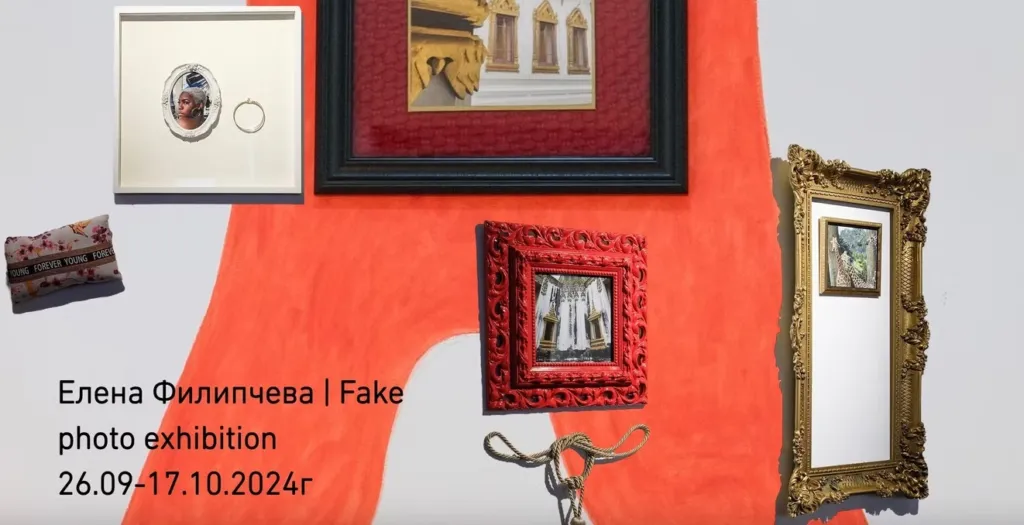
Elena Filipcheva | Fake Photo Exhibition 26.09 – 17.10.2024 Curator: Filip Popov “Photography is more than a means of factual communication of ideas. It is a creative art,” states the legendary American photographer Ansel Adams (1902–1984), as if laying the foundations of an enduring debate—can photography be art, and be admitted to the honorary club of all those who call themselves and their work—artists and art. This rather rhetorical question has preoccupied many renowned photographers, who have left a clear trace with their legacy, and long ago proved that they do everything Edgar Degas wrote about: “Art is not what you see, but what you make others see,” or, alternatively, confirm Pablo Picasso’s categorical assertion that “art brushes away from the soul the dust of everyday life.” In Elena Filipcheva’s exhibition, which already in its title posits the freedom of interpretation as a fundamental rule—Fake Photo exhibition—22 photographs, in an odd, at-first-glance communication with materials, frames, and objects, recount a journey through Thailand, Cambodia, and Singapore, with a sense of insufficiency of touch and emotion, finding their added value in Paris. And just as art itself can bring the inexplicable into harmony, Elena Filipcheva’s photographs step beyond the limits of traditional perceptions of photography and boldly introduce unexpected provocations. The author, Elena Filipcheva, lets the inspiration—shaped by the photojournalist’s distinct gaze—carry the narrative to another level, where, without words, a vision of Eastern mystery meets the materiality of Western reality: collages of memories, desires, dreams. An understanding of one world and strange observations of another—unknown and misunderstood. A journey of tangled thoughts between liking, curiosity, and rejection. A colored cloud that takes on different forms so that, as we watch it, our imagination can invent the image we perceive. And if travel is an experiment of the spirit, then in Elena Filipcheva’s unusual photographs it alternately delights, raises questions, distances itself, contemplates, or else curiously peers behind walls, water, plants, or human faces. Each protagonist tells their own story and seeks no points of intersection—neither with reality, nor with the other participants in Filipcheva’s distinctive artistic collage. The photo-enlargement—forever associated in cinema history with Michelangelo Antonioni—within Fake Photo Exhibition has moved beyond the bounds of intimate experience between the subject and the photographer, provoking an artistic gravity with a free flight into a reality you neither explain, nor test, nor forcibly enter, but sink into in quiet contemplation, with a clear awareness of the limitations of time and space. And the total freedom of personal interpretation—actually a deeply intimate photo-enlargement in the first person singular. Krasi Genova