Georgi Yankov is an author well known to the Bulgarian public, who with his appearances in recent decades has invariably broadcast various visual and semantic constructions into the cultural space. Commanding respect with their unexpectedness. One could begin with the fact that he is a proven master of poster art and graphic design. And this fact cannot help but leave lasting reflections on everything he does, including the current exhibition, consisting of paintings in the most classical sense. It is characteristic of Yankov to “crossbreed” techniques and materials, and it is no coincidence that there was a period in which the imagery of his posters came from the photographed objecthood of complex objects and even installations he constructed. I will take the liberty of reminding you that a few years ago his last exhibition was related to the emphasis on a specific materiality, as light and kinetics transformed the impact of metal, wood, glass, and the “ready-made objects” used.
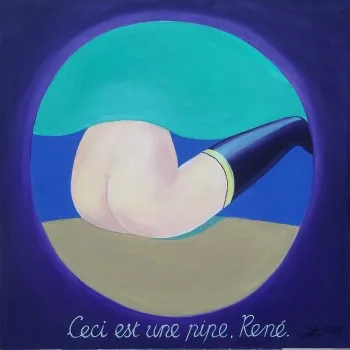
In the current exhibition, Georgi Yankov has focused on medium-format oil canvases, all resolved as squares. In them, we again observe the balancing on the thin line between seriousness and jest typical of this author. A good example in this direction is the painting EXIsT, which, besides being a compositionally minimized work with restrained coloring, also represents a play on words. The letter S has turned into a horizontally placed door handle, whose direction of pressing decides the question of existence or the exit from it. In the work “The Temple,” the bow of the boat becomes a dome with a cross, and the fish become clouds, but the opposite could also be said. Elsewhere, a playful nod to René Magritte’s famous negation of the pipe is intentionally sought, in “This is a Pipe, René,” as well as in “This is Not an Accordion.”
A spatial accent in the gallery are the works painted on bed headboards, standing in the boundary position between the object and the pictorial surface. A duality characteristic of the so-called Neo-Dada from the middle of the last century. And again resourcefully used by Georgi Yankov for the purposes of this specific exhibition in works such as “Batman,” “Black and White Television,” and “Escape.” This is an exhibition that hides a vast wealth of meanings, because it is itself something of a repository of senses and a crossroads for possible inventions.
Svilen Stefanov