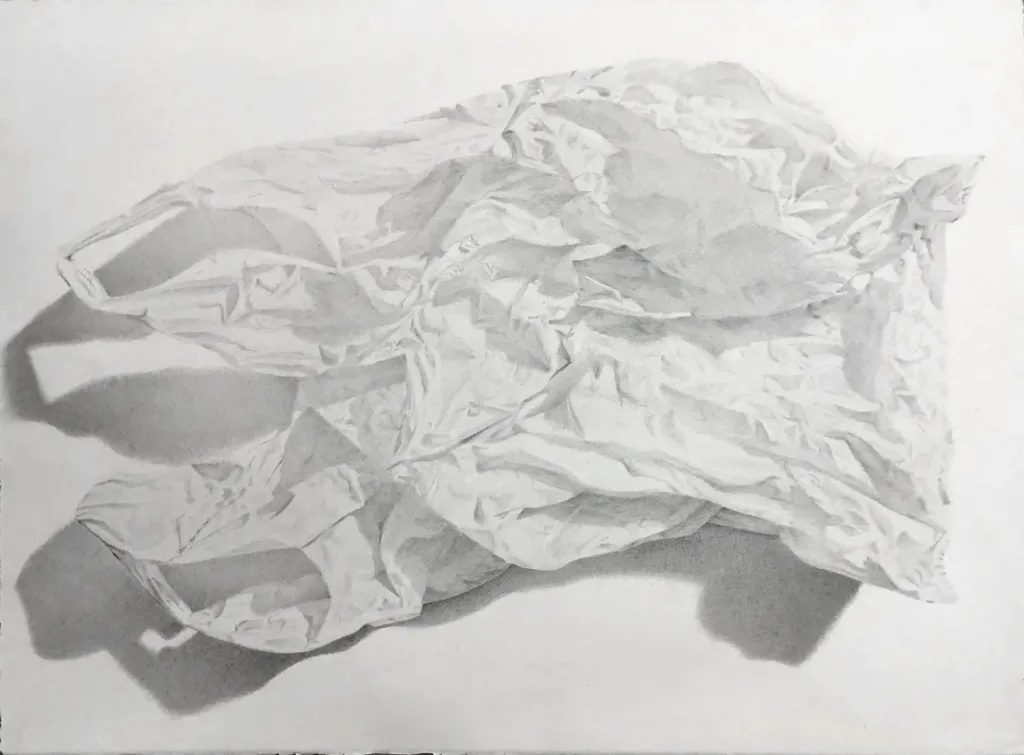
Natan Pernick (b. 1980) was born in Kfar Mordechai, an agricultural settlement, and graduated from the Bezalel Academy of Arts and Design in Jerusalem. He spent two years in New York, from 2002 to 2004, as an assistant to Mark Kostabi, a well-known contemporary artist who, besides his art, is renowned for two things: his virtually factory-like method of producing artworks and his politically incorrect statements. Pernick first emerged as an independent artist in 2009, only five years after returning from the United States, when he participated in the New Art Festival in Tel Aviv; later that same year, his work was shown at the National Portrait Gallery in London as part of the BP Portrait Award. By then, he had become a hyperrealist artist, with the visual precision of his images approaching that of photography. Hyperrealist portraits and Israeli desert landscapes formed Pernick’s first solo exhibition, The Opening Statement (2010). Although somewhat different from his later works, they radiate a serenity akin to that of Zen Buddhism. Already apparent in them is what would emerge more clearly in the artist’s subsequent projects: wet pockets, plates of frittata, fogged spoons, broken sticks, and other objects that have lost their functional purpose and drift through the vacuum of an airless space. Ruined objects as a metaphor for human existence are not a new theme, either in art as a whole or in Israeli art in particular. Another Israeli hyperrealist, Eran Reshef, employs a similar device to capture the remnants of old Tel Aviv. As Israel begins to develop rapidly, symbols of a bygone era—things falling out of use—become objects of reflection for those who can still remember the country as a small provincial state. Pernick’s tension, however, lies in leaving the reflection outside the technique itself. The artist transforms each depicted object into a sensory element of his visual language and analyzes the relationships between these units and the three worlds: the real, the imaginary, and the symbolic. This is a phenomenon Georges Bataille describes in his 1948 lecture “The Surrealist Religion”: “Modern man has an inherent longing for myth, and we must add to this the realization that we cannot attain a state in which human beings are capable of creating a true myth. This absence of myth may prove far more inspiring to those who experience it than the myths of the past.” Pernick compensates for the absence of mythology by relocating signs of existence whose meaning has been lost into airless spaces, connected only by an indistinct shadow. If painting here addresses semantics, it concerns the relationship between the signs into which the objects have been transformed and their meaning; the installation then places the viewer within the realm of pragmatics—the relationship between signs and their users. This combination of media appears to conceal an attempt to answer the question posed by the exhibition’s title: what will happen if we make one more mistake by treating a symbol that has lost its functionality as an endpoint? What will happen if material fatigue is in fact the first step toward renewal?