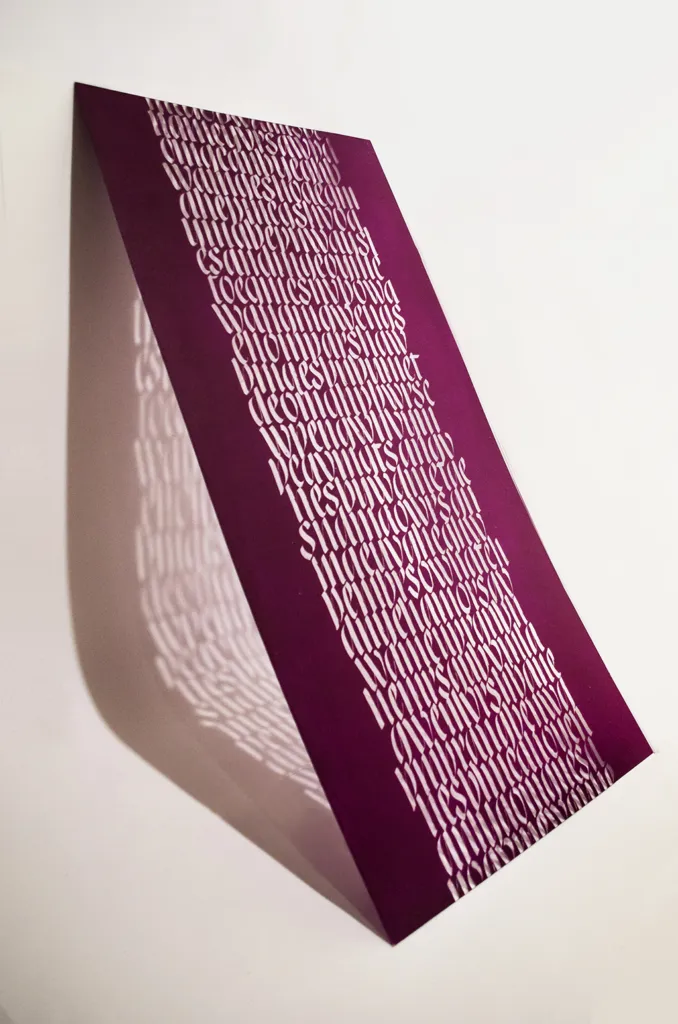
Light and Word This exhibition presents two artists who completed the master’s program in Calligraphy in the Department of Poster and Visual Communication at the National Academy of Art: Tsvetislava Koleva and Zhaklina Simova. Calligraphy is, by its very nature, an exceptionally refined art form. In its contemporary manifestations, it has long transcended the boundaries of beautiful writing and entered the realm of genuinely conscious and deeply experienced creative exploration. The results are subtle and profoundly compelling graphic works realized through the art of lettering. The two collections presented in the exhibition are united to some extent by a shared underlying principle: the leading role of light. Here, light is not merely a means of perceiving the individual works but a fully fledged participant in each of them. Light becomes a visual medium that allows viewers to immerse themselves in the artist’s vision and fully appreciate its aesthetic message. The exhibition also includes accompanying interactive visual materials illustrating the processes through which the principal works were created and their possible transformations, thus enabling a deeper understanding of their artistic messages. In addition, a collection of artist-designed bookbindings by K. Borisova and T. Galov will be displayed in the transitional spaces, supporting and completing the exhibition’s overall vision. Original prints from the two collections featured in the exhibition will also be available for purchase. Zhaklina Simova Zhaklina Simova earned a bachelor’s degree in Poster and Visual Communication from the National Academy of Art in Sofia, followed by a master’s degree in Calligraphy from the same institution. Upon graduating, she received a special certificate from New Vision International Group in recognition of her creative contribution and was also admitted as a full member of the association. Zhaklina Simova’s graduation work is an independent artistic project that seeks to present calligraphy throughout its historical development not so much as a vehicle for text and information, but rather as an integrated graphic message—as texture and pattern. The resulting work is, naturally, an expression of the essence of the period to which each calligraphic standard belongs. Particularly original is the choice of medium through which the final result, refracted through the artist’s mind and sensibility, is presented: plexiglass panels on which the respective compositions appear in negative. This allows light to become an active structural element, generating provocative graphic images. The addition of color further encourages an active perception of the artist’s intended message. Equally important to a complete appreciation of the collection is the series of preliminary studies—meticulously executed calligraphic works in their classical form. Alongside these works, the collection includes a wealth of interactive material documenting their creation and presenting the many transformations of Simova’s work as a symbiosis of letters and light. Tsvetislava Koleva Tsvetislava Koleva is a designer based in Sofia, Bulgaria. Her work is an intriguing blend of paper objects, calligraphy, and graphic design. By combining precision with vivid colors and graphic compositions, she brings her work to life. Whether masks, animals, or birds, these subjects are always deconstructed and reimagined through her own perspective. She graduated from the National Academy of Art in Sofia with a bachelor’s degree in Advertising Design and a master’s degree in Calligraphy. Tsvetislava is currently part of the Four Plus studio team. Her projects have been featured in exhibitions and competitions including the 2018 Typography Competition of Communication Arts, One Design Week 2016, Paper Art Fest Sofia, and the Arjowiggins Second Skin Contest 2013. Her graduation project, “Strokes, Shapes & Light,” was among the winners of the eighth annual Communication Arts Typography Competition. The thesis presented is based on a series of preliminary studies intended to establish a connection between the mark left by a particular writing instrument and its most appropriate equivalent fashioned from paper. The objects analyzed include the traditional metal nib, round and flat brushes, Terylene, and foam board. The results of these studies take the form of several remarkably crafted plastic calligraphic objects, representing only the first stage of the project. Their subsequent interpretations are high-quality photographs that reveal the symbiosis of volume and light, producing results that are always distinctive and provocative for the viewer.