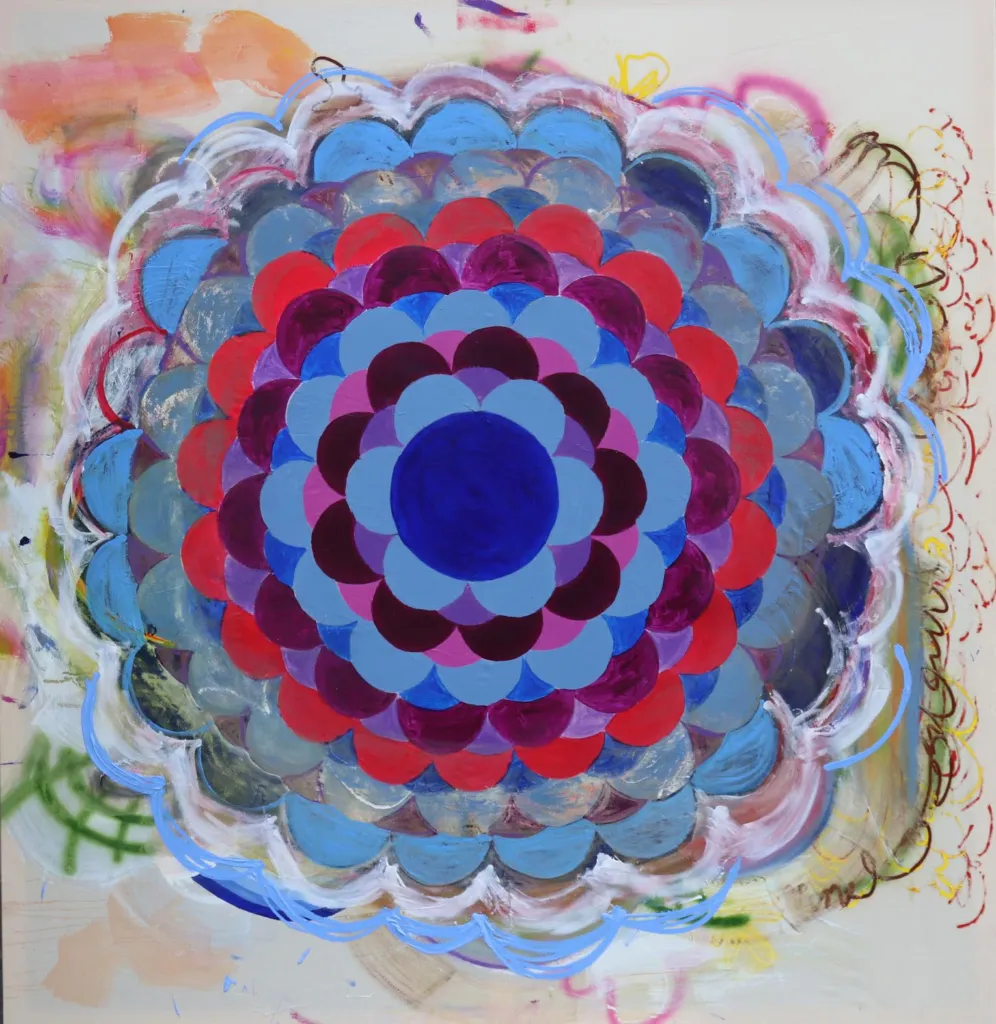
Edward Grainger Since the dawn of humankind, the circle has captivated the human imagination. Whether it is the shape of the full moon crossing the night sky or the colourful irises that gaze at us on the street, the circle is everywhere. Throughout history, the circle has touched every aspect of human culture: the visual arts, mythology, religion, navigation, mathematics, science, marketing and film. Completed in a single continuous line, the circle is perfect—and sometimes imperfect. It is an infinite cycle and, given its omnipresence, surely the most powerful of all naturally occurring symbols. The circle often represents an eternal cycle: the personal journey towards self-discovery, spirituality and sexuality. As an infinite symbol, the circle itself may be regarded as “alive.” Just as we assign meaning to the circle based on its form and structure, we can give ourselves an identity through the position and form we assume within the society around us. This group of spiritual works, entitled “Labyrinth,” can be seen as a complex network of passages and stages of life in which people find their direction or identity through social “customs” and the breaking of rules. The aim is to illuminate the fundamental role identity plays in society and to challenge how we see and relate to ourselves. Through the use of various symbols—above all, the circle—the viewer is invited to interpret ideas of balance, continuity and strength. Colours influence the perception of a person’s physical and emotional state. In contemplating each work, the eye is compelled to perceive blurred lines, forms and colours, and thus to consider how best to identify itself. Each work uses blurred lines to express the idea that boundaries and limitations can always be removed. The stains and imperfections in every piece represent the traces humankind leaves behind through movement, migration, life and death. Different materials are used to express oppositions that exist today: organic versus synthetic, natural versus distorted. The artist uses fire to leave marks on each work. These traces represent the destruction inflicted by society. It is precisely this destruction that consumes the individual: even if one part burns away, the other is transformed. This very metamorphosis imbues each work with the hope that people can pass through fire to reshape, change or transform themselves. The artist challenges the idea of an immaterial life that prevails in the contemporary digital age. Technology has transformed life and self-expression through social media, creating a sense of precision and tangibility in a way that physical life rarely does. Through the circle, viewers can reconsider “their own” perceptions and discover the potential for change.