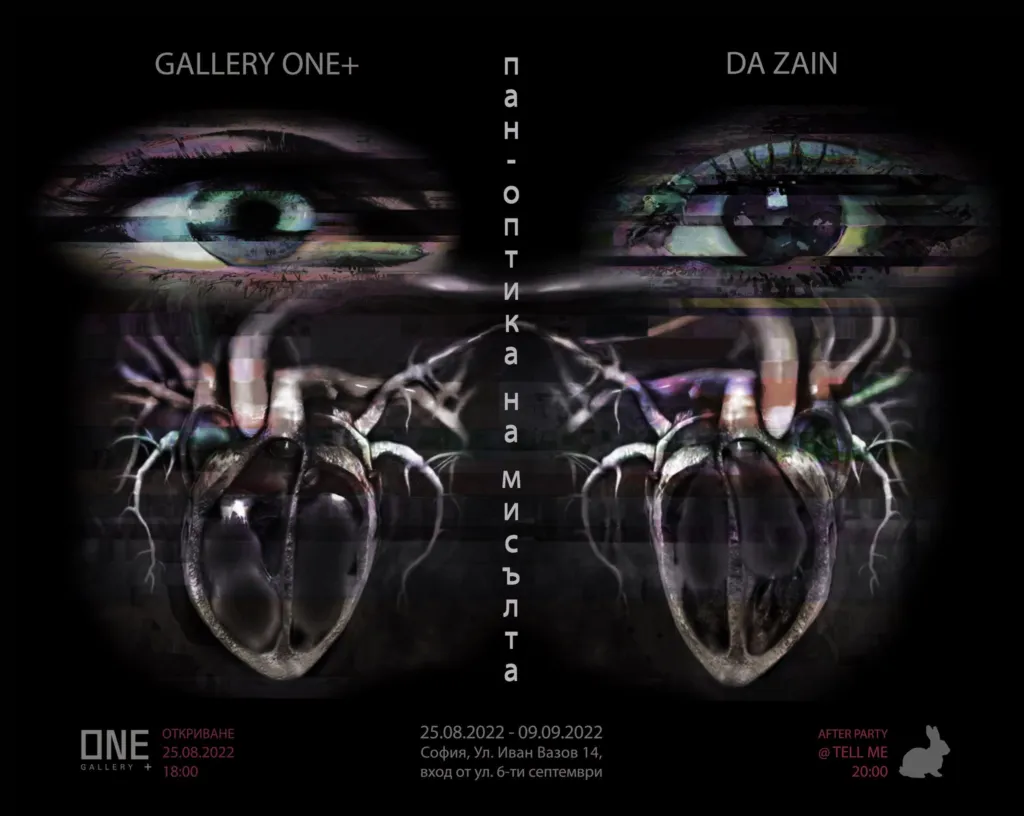
(Pan)Optics of Thought Solo exhibition by Yona Pelovska (Da Zajn) 25.08 -09.09.2022 “(Pan)Optics of Thought” is an exhibition project bringing together two transmedia installations that explore the phenomenology and mythology of cinematographic technologies. They share a specially devised format for juxtaposing lenticular animations activated by the viewer’s movement with video projections that problematize the viewer’s usual fixed position. This format calls into question the relationship between embodiment and technology, inviting the viewer to experience the contrast between the physical arrest of single-channel film/video projections and the viewer-movement-activated image of the holographic environment. In the tradition of McLuhan’s ideas about media formats as semantic conduits, “(Pan)Optics of Thought” activates meanings embedded in specific media frames, foregrounding the ways in which media frame thought. Each of the two series unfolds the media–body–mind question through its own thematic and aesthetic focus. While “The Eyes That Stop Trains” relies on analog techniques to prompt a meditation on the lived experience of perception–thought filtered through cinema technologies, “(Pan)Optics of Love” explores the problems of digital art as media fissures through which ancient mythologies of vision-as-knowledge seep and are refracted through contemporary techno-human framing. The viewer is immersed in an environment that disrupts continuity and displaces expectations in order to provoke new alchemical reactions between embodiment and meaning. How do we dream realities? From ancient Egyptian labyrinths and early cinema “mirrors” to post-industrial technologies, “(Pan)Optics of Thought” invites the viewer to encounter a knowable world at the intersection of collective dreaming, personal reality, and impersonal technology. The Eyes That Stop Trains Moments of life—lived, missed, remembered, and forgotten—seen through the window of a moving train. A view onto thought and vision, playing the film of life—the eyes looking through the window. The installation consists of six illuminated lenticular panels in dialogue with screens showing the original video series, which together form something like a train corridor of “windows” onto a moving landscape. The lenticular animations are activated by the viewer’s movement/viewpoint, while the videos run independently of the viewer’s position, calling into question cinematic time and its relationship to physical movement, staged through two different media. By examining different mediated experiences of a video series, the installation questions the phenomenal relationship between viewer and moving image that underpins the primacy of the subjective gaze. With this project, the fascination of early cinema with the moving train is reanimated as a metaphor for the techno-animating image. The lenticular prints and the videos are paired with a short film. While the corridor of video and lenticular “windows” invites the viewer to explore the time of animation through physical movement, the video projection—with rapid editing of fragments of visualized thought that interrupt the frames of the continuously moving train—arrests the viewer, demanding their undivided attention. The installation is a meditation on the temporalities of perception and thought—the way mental fragments cut across perception. The moving train => time-thought => the moving image. The beginning of cinema: “Arrival of a Train at La Ciotat” by the Lumière brothers, seen from the position of the passenger. The flow of time, heard through the ears of John Cage, “Bacchanal”—the sound of life, dynamic and chaotic; the pulse of time, reversible and reproducible unto death. The installation explores the living and imagined modalities of cinematic media and the ways they compete with our most intimate relationship with the world: the mind. (Pan)Optics of Love (Pan)Optics of Love is a techno-shamanic exploration of seeing as love. From technology to the mythology of vision, this project gathers meanings in order to rethink how sight assembles visual reality. Drawing on ancient insights and dreaming practices, the project mobilizes the electric force of new technologies to resurrect the work of art as a miraculous gesture that opens a gaze toward the unknown. “(Pan)Optics of Love” is a poem about vision as a window onto the invisible. Interpolating traditional notions of an all-seeing God with the surveillance potential of contemporary digital technologies, the work investigates questions of privacy, secrecy, knowledge, and revelation, tracing how fear of technologies as a panoptic observer can transform into a loving communion with the technologically impossible. “(Pan)Optics of Love” is an expanded cinema series—nonlinear audio-visual-textual physical and digital segments, (hyper)linked with one another, compose what I call a cinematographic book—drawing on the potential of digital platforms for nonlinear interactive editing. Selected visual components are developed as lenticular prints—an analog print that enables an animation effect, activated by the viewer’s position, placing it in direct dialogue with the emanations of the artwork. The eyes of the celestial lights, the ancient Egyptian divine beings Ra and Thoth, watch the observer, while the seat of true vision as a creative origin—the heart—beats in an unbreakable bond with its dreaming double, activated by the viewer’s attention.