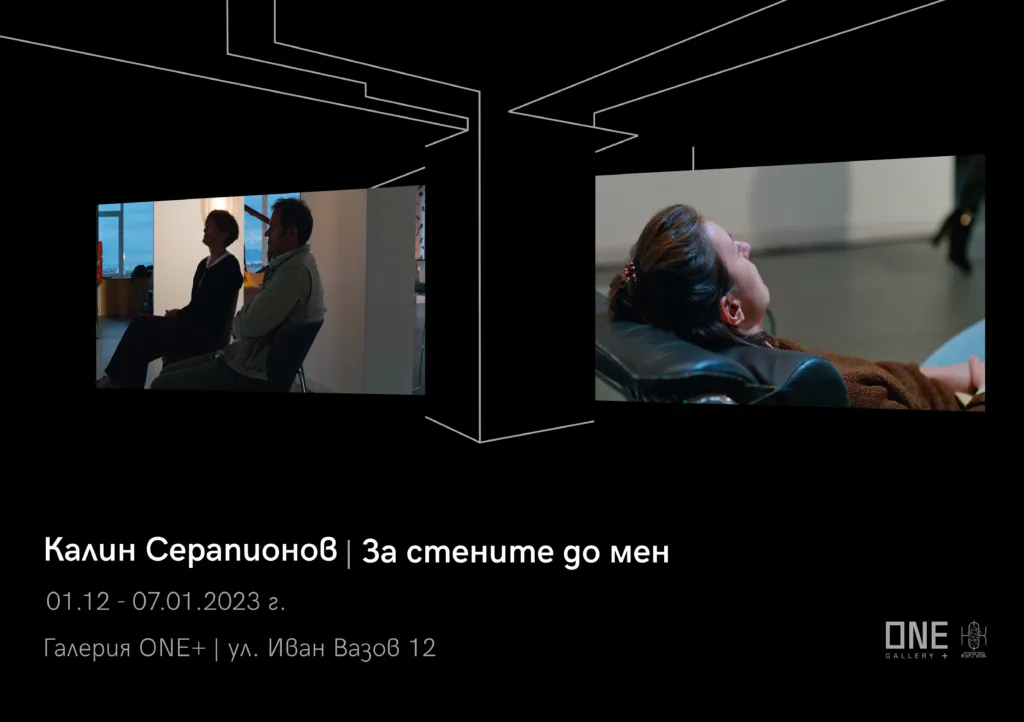
Kalin Serapionov | The Walls Beside Me 01.12–29.12.2022 “The Walls Beside Me” is a video installation with a performative realization, constructed from shots of many unfamiliar people who temporarily inhabit a specific space. Along with their bodies, some are present there with a cherished object brought from their own home. Over the course of about an hour, they connect with one another—not through words, but silently. At the core of the project is the method of family constellations. Our individual behavior, feelings, and attitudes are examined and made sense of in the context of the larger group, since each person is part of a given family and takes on certain roles within this structure. The venue is Etage 8—on the eighth floor of an industrial building located on the outskirts of Sofia. The specificity of the architecture (a glazed space on the top floor) turns it into something like a detached capsule within the overall urban environment. Seated inside it, one has a panoramic, distant view in all directions. One can observe the residential neighborhoods, the industrial zones, the mountain, and analyze the city’s dynamics. The aim is for this space to be brought to life by the presence of people—without speaking—under the sounds of their own bodies and of silence. ___ Yorgos Lanthimos’s film “The Lobster” transports us into a dystopian setting in which people without an intimate partner are forcibly sent to a special hotel, where they have 45 days to find one; if they fail, they are turned into an animal of their choice. Under the pressure of this threat, the protagonists make every possible effort to fit into what is considered acceptable social behavior, drawing on their entire arsenal of knowledge—whatever it may be—and, ultimately, failing. The narrative problematizes conventions of human relationships, the individual’s vulnerability within a group, and change. In his project, similarly to Lanthimos, Kalin Serapionov constructs a sterile environment for social communication, setting basic rules—no words—and a single goal: communion. In the process of adapting to the unusual situation, primal human instincts and forms of exchange surface—usually suppressed in everyday life by our drive for productivity. The participants, seemingly constrained by the ban on verbal communication, appear rather liberated by it—they give themselves over to introverted activities: play, contemplation, sleep. Beyond the risk of being turned into a lobster or a pony (or suffering any lasting negative consequences), the individual gains the possibility to use time, space, even their own body, entirely according to personal desire. As time passes, participants also move toward social activities, but these, again, are delicate and non-invasive. Silent, the participants (once again) turn to the body as the primary medium of expression. We observe how, in some cases, augmented by the inseparable prostheses of technology, it takes part in new rituals of constructing intimacy—those of contemporary cyborgs. At times the body is self-sufficient, seeking surfaces and fabrics; at other times—other bodies. In sync with the cracking of capitalist ideology, the participants’ behavior may be symptomatic of the contemporary person’s need for rest and for rethinking our ideal of a fulfilling life. _ Credits: DoP (cinematographer) Tilman Rödiger Steadicam operator Borislav Belberov First assistant Eva Petrunova Steadicam assistant Vanya Ivanova Gaffer – Dimitar Yordanov Editing Kalin Serapionov Sound Georgi Atanasov Video equipment, installation and sound Dimitar Apostolov, Kiril Yanev, Studio Balkandzhi Special thanks to Elena Antonova, Georgi Nikolov, Magic Shop, Orlin Ruevski, Momchil Tashev. / With the support of the National Culture Fund through the program “Annual Grant 2021” and the “Program for Recovery and Development of Private Cultural Organizations”.