AFTERIMAGES
Solo Exhibition by Svilen Stefanov
Curator: Suzana Nikolova
30.11.2021 – 07.01.2022
Vernissage: Nov 30, 5 PM
The exhibition presents works that are either new or previously unshown. Following periods of turbulent transformation in the sphere of non-conceptualist forms, Svilen Stefanov turned to painting in the late 1990s. He deliberately creates cold conceptual painting, in which he utilizes expressionist means in a secondary manner. His approach is conceptual, yet simultaneously classically painterly, because conceptualism is a way of thinking.
In Bulgaria, this has been a different kind of painting since the 90s, developing alongside conceptual strategies and forming a part of them. It is not a negation of conceptualism, but its continuation. The author creates conceptual painting using classical means, because conceptualism is a rational form of art, yet the sensuality of the painterly surface serves as a reminder of its material nature, and it is precisely this that lies at the center of his interest. In contemporary art, the goal is not to discover something “great,” but the way in which you interpret it.
Afterimages is not a new theme (see the film of the same name by Andrzej Wajda), but it concerns the author’s entire body of work. Afterimages of existing or future paintings remain in the visual memory as vague images, superimposed like filters, shadows, and reminiscences. This theme provides a cinematic perspective on the reading of the image. Here, nothing is unambiguous, and the interpretation of the painting depends on the viewer.
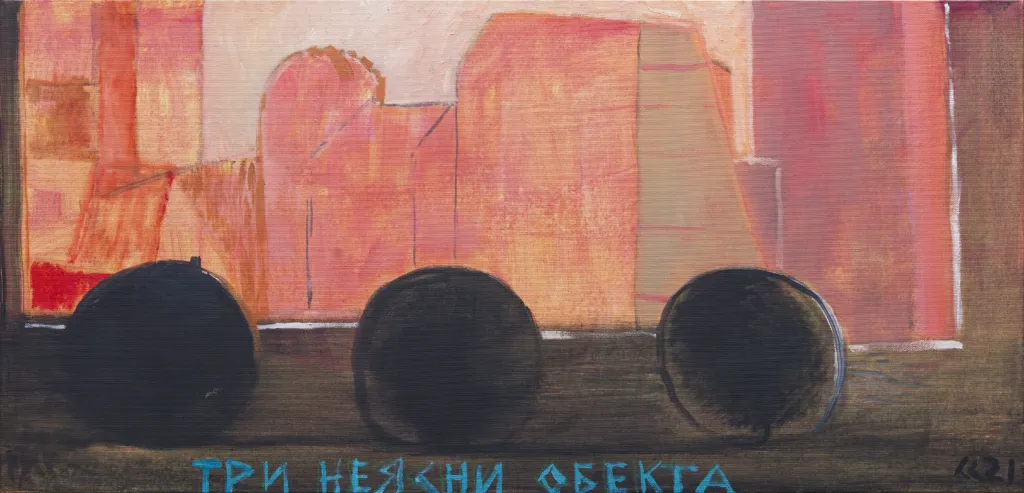
Stefanov is known for using conceptual strategies in painting, such as incorporating text into the image, which is not the establishment of a literary foundation but rather an idea. At first glance, large, colorful inscriptions perceived with a sense of humor (“The Spirit of the Capilla,” “Wolves Crossing the Ice of the Danube,” “Obscure Lesson in Geometric Abstraction”) are actually connected to cinema, art history, and music. The images accompanying these texts are not illustrations of the text, but rather a synthesis between image and text with an alternating dominance. In short—the texts do not explain the images, and the images are not illustrations of the texts. Everything is intertwined with irony, and it is difficult to find a direct, specific, unambiguous meaning. The embedded hidden meanings can be interpreted differently by each of us.
In Svilen Stefanov’s canvases, reverse perspective is the correct way of looking at things. Shifting the focus lends a surrealist psychologism to inanimate objects. Watermelons and bananas become central objects, charged with emotion and psychology. The tension in the stasis of the objects comes from the strong color values in the canvases. He builds the painting through rich imprimaturas and glazes. He slowly layers light tones, applied like transparent veils. The “oily” effect of oil paint is absent. Only in the inscriptions is there a definitive and impasto application of paint.
Numerous figures, part of something organized, are situated within a wide panoramic landscape. Small, faceless people are engaged in insane processions, funerals, gallows, and welcoming aliens. Svilen Stefanov achieves absurdism in painting by shifting the emphasis from people to objects, elevating materiality to a primary meaning, and portraying objects—a large leek, two watermelons, bananas. His painting is characterized by intelligence, a sense of humor, and a total lack of pretension. He possesses the skill to turn grand themes into everyday ones and vice versa, but without underestimating them. Simply with a smile.
His characteristic elongated formats suggest horizontal development, while a composition of two objects suggests symmetry. Svilen Stefanov moves beyond the standard reflex of the academically trained artist to seek the golden ratio, a central axis, or a three-object composition. He is not afraid of mirror symmetry and steps between the beats.
In “Afterimages,” the messages and images the author has been working on in recent years are conveyed in a refined, compressed version. This is a creative experiment that once again proves Svilen Stefanov is one of the most successful painters in Bulgarian art today.
Suzana Nikolova